Before the Rag Bag: How Worn Cloth Found New Uses at Home
Worn cloth can become a useful household cleaning cloth when you match its fabric and condition to a suitable second job before discarding it.
The common mistake with worn cloth is tossing it straight into a rag bag before asking what job it could still do. That can cost a household a handy cleaning cloth, dust cover, or polishing square—not because every old garment is useful, but because fabric often outlasts its original purpose. Reuse begins with one small decision: assign the cloth a second role before you discard it.
Start With Its Next Job
A shirt that no longer belongs in a drawer may still be soft, absorbent, or sturdy. Those qualities point toward different uses. Cotton jersey, such as a worn T-shirt, makes a flexible wipe for dust and spills. A smooth cotton pillowcase can become a lint-light cover for a shelf-bound object. A thicker flannel shirt may suit grubby cleanup, provided its buttons and seams are removed from the working area.
Think of reuse as matching, not rescuing. The question is not “Can I keep this?” but “What ordinary task would this material do well?” A clear answer prevents a pile of fabric from becoming an obligation. If no reasonable task comes to mind, the cloth need not be kept simply because it could be cut into something someday.
Read The Fabric
Look at the weave, surface, and condition. A loosely woven piece may snag or leave fibers behind. A smooth, tightly woven one may be more suitable for wiping glass or polished surfaces, though a clean microfiber cloth is often the better choice for delicate finishes. A cotton towel with a roughened surface can lift crumbs and grime from a worktable. Stretchy knit cloth bends around a hand and reaches awkward corners.
Fabric blends matter, too. Synthetic fibers can behave differently from cotton around heat, solvents, or delicate finishes. For ordinary household wiping, keep the cloth away from tasks that require a material-specific tool, and follow product labels and manufacturer instructions where they apply. Never turn an unknown fabric into a tool for hot cookware, chemical handling, or other work where the material’s limits are uncertain.
Condition sets boundaries. A faded patch is usually just cosmetic; a greasy stain, musty odor, brittle area, or persistent residue may rule out a cleaning role. A cloth that sheds lint can still work on rough surfaces, while it may frustrate anyone trying to polish a mirror. Let the intended task decide whether an imperfection matters.
Prepare A Useful Cloth
Before cutting, wash the garment or household textile and let it dry fully. This clears away ordinary dirt and helps reveal whether stains, odors, or loose fibers remain. Check care labels when available. If the cloth still seems unsuitable after laundering, choose a less demanding use or discard it through an appropriate local textile option.
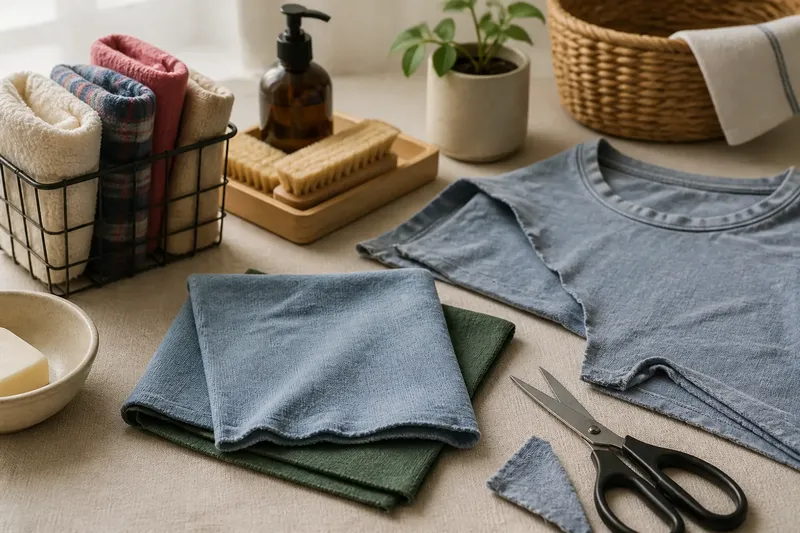
Then make a piece sized for the job. A broad panel works well for wiping a table; smaller squares are easier to grip for dusting. Cut away zippers, snaps, hooks, and thick seams that could scratch a surface or catch on an edge. With a T-shirt, the body often provides a smooth panel, while the hem and sleeves can be kept for rougher tasks. There is no need to make every scrap into a separate cloth.
Raw edges may curl or fray, especially on knits. That does not always prevent use, but a simple hem can make a cloth easier to handle if you sew. If you do not, cut a clean rectangle and watch for loose threads during use. A pair of fabric scissors helps produce a tidier edge than kitchen shears.
Give Each Cloth A Boundary
One second role is often enough. Reserve a soft, clean cloth for dry dusting, another for routine kitchen spills, and a rougher one for messier jobs such as wiping garden tools. Keep cleaning cloths separate from items used on food-contact surfaces unless they are washed and stored appropriately for that purpose. Color or a small mark can help distinguish jobs, but avoid adding a labeling system so elaborate that it becomes harder to maintain than the cloths themselves.
Imagine you have a worn cotton T-shirt with a sound body but stretched collar and stained cuffs. You wash it, find the body remains clean, and cut two broad squares from the front and back. One becomes a dry dust cloth; the other is kept for wiping a workshop shelf. The expected observable result is simple: each square has a clear task, and the damaged collar and cuffs do not dictate the fate of the usable fabric.
Set limits on where a cloth may go. A wipe used for muddy shoes should not drift into the kitchen. A cloth that has touched grease or a strong cleaning product belongs in a separate wash load or disposal route, depending on the material and local guidance. The point of assigning a role is to make the cloth useful, not to blur cleanliness boundaries.
Use And Store It Sensibly
After use, let a damp cloth dry rather than leaving it balled up in a sink or bucket. Wash reusable cloths according to their fabric and the cleaning task. A dedicated laundry basket or a washable mesh bag can keep used cloths distinct from clean ones. Store dry cloths in a simple, accessible spot near the work they serve; a folded stack on a utility shelf is often easier to manage than a deep container filled with every scrap.
Inspect the cloth as it gets used. If it begins shedding, holds an odor after washing, or develops a stain that transfers, retire it from the task. It may still suit a rougher job, or it may be time to let it go. Reuse is not a command to keep material indefinitely; it is a way to notice remaining usefulness before disposal.
Choosing A Second Role?
Can any old fabric become a cleaning cloth?
No. Fabric that is contaminated, persistently odorous, or prone to shedding may be unsuitable for household wiping. Match a clean, stable material to a task where its texture and condition make sense.
Which cloth is best for glass?
A smooth, lint-light cloth is preferable to fuzzy flannel or a fraying knit. For delicate glass or coated surfaces, check the care instructions and use a purpose-made cloth if needed.
Should I sew the edges?
Not necessarily. A clean cut may be enough for a rough-use wipe, while a hem can make a frequently handled cloth neater and more durable. Choose the effort to suit how often the cloth will be used.
When should I stop reusing it?
Retire it when washing no longer removes residue or odor, when fibers transfer to the surface, or when wear makes it unreliable for its assigned task. A final useful role is better than keeping a cloth that has become a nuisance.
Let The Role Come First
The rag bag can be a useful destination, but it works best as a place for cloths that already have a purpose. Before a worn textile goes there, notice what remains: absorbency, softness, a sturdy weave, or simply a piece large enough to cover a dusty object. Choosing a second role first keeps reuse practical and selective. For household cleaning cloths, that small pause turns “too worn to wear” into a clear, manageable job—or an equally clear decision to let the fabric go.