Drawer Dividers or Small Boxes for Spare Buttons
Compare drawer dividers and small boxes for spare buttons, then choose a setup that keeps a changing collection visible, sorted, and easy to use.
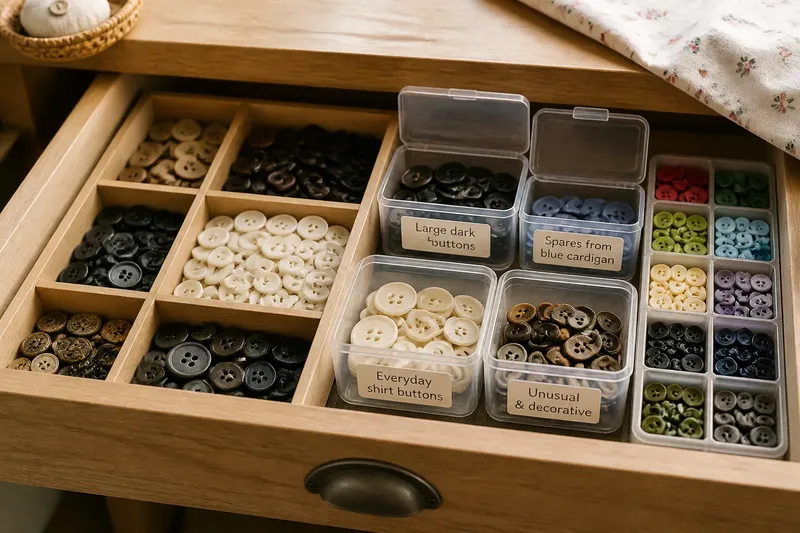
The common mistake with spare buttons is tipping them into one deep drawer compartment, where tiny ones vanish beneath larger pieces and matching pairs get lost. Drawer dividers or small boxes for spare buttons prevent that muddle in different ways: dividers keep familiar groups in place, while boxes move with a changing collection.
Choose by asking how often buttons arrive or leave, and whether you can spot the kind you need without rummaging. A cutlery tray, bead organizer, or clean carton may already provide a useful home.
Changing collections
A collection that rarely changes can thrive in fixed drawer dividers. Each section stays put, so familiar categories are easy to maintain. One compartment might hold shirt buttons, another larger coat buttons, and a small end section those saved from garments you no longer own.
Fixed compartments suit people who sort once and keep the same basic groups. A wooden cutlery organizer or sturdy plastic tray can create clear boundaries without requiring a dedicated sewing box.
But an unevenly growing collection can strain a fixed grid. One compartment may overflow while another sits nearly empty. If you keep acquiring buttons from mending, thrifted garments, or family sewing supplies, a fixed layout may force you to split a useful group or mix unrelated pieces.
Small boxes are more forgiving. Move one, add another, or combine two groups without rebuilding the whole layout. This helps when the collection changes in bursts, such as after sorting a sewing basket or removing buttons from a worn-out shirt.
Say you have a shallow drawer with a cutlery tray and a growing handful of buttons from recently repaired clothes. Put everyday shirt buttons in one small lidded box, leaving the tray’s other sections for larger and unusual pieces. When another batch arrives, place it in a second box rather than crowding the first. The observable result should be a defined place for each category, even as the collection grows.
Visibility and labels
Seeing the contents at a glance matters. Buttons are small, often similar in color, and easily hidden when piled. A low, open divider lets you scan the surface quickly. Choose compartments not much deeper than the buttons they hold, so a few large pieces cannot bury a layer of tiny ones.
Small boxes can be just as visible if they are shallow and open, or have transparent lids. A clear bead organizer is handy when each cell holds a distinct type, though its many small compartments may feel fussy for a casual collection. A translucent craft box offers fewer, roomier sections.
Opaque boxes trade instant visibility for protection from dust and accidental spills. Use a legible label on the top or side to make up for that. “Large dark buttons” or “spares from blue cardigan” says more than a vague “buttons” when several boxes look alike.
Pay attention to the drawer as well as the container. A low box may be visible only when the drawer is open all the way; a tall stack may hide its lower contents. Arrange containers in a single layer where possible, and keep the most-used group near the front.
Sorting styles
Fixed dividers invite categories that stay put. Sorting by size, color, or likely use can all work, but choose a rule you can maintain. If you mostly sew everyday clothes, separating common shirt buttons from larger coat buttons may be more practical than giving every shade its own section.
Movable boxes make it easier to sort by source or project. One container can hold buttons saved from a garment, keeping matching spares together. Another can collect distinctive buttons awaiting a future repair. When that repair is finished, move the box into a broader category or keep it intact if its contents are useful as a set.
Avoid creating more categories than the collection can support. A divider with many empty cells can encourage needless sorting, while a stack of tiny boxes can turn finding one ordinary button into a miniature search. Start with a few distinctions that answer real questions: Is this the right size? Does it match the garment? Is it ready to use?
Access and containment
Open compartments offer quick access. Reach in, pick up a button, and return it without handling a lid. That convenience works best when the drawer stays level and is not shared with items that jostle the contents.
Small containers keep their contents together when moved. Lift a lidded box to a table or sewing basket, then return it to the drawer without scattering pieces along the way. This helps if you mend in different rooms or share a drawer with household items. A lid also reduces spills if the drawer is pulled briskly.
Check the fit before filling containers. A box that catches on the drawer edge or slides behind other items can make the collection harder to use than a simple divider. Reuse clean, sturdy packaging only if it sits securely and its opening is broad enough for fingers to retrieve small pieces.
For a mixed setup, use the drawer divider as an outer frame and place a few small boxes inside selected sections. Keep frequently used buttons in open compartments; reserve boxes for matched sets, unusual pieces, or categories that change. Each container should have a clear purpose and remain easy to reach.
Drawer shape
A wide, shallow drawer favors low dividers. They spread the collection across the available area, with each group visible from above. An expandable cutlery tray may fit a changing drawer width, while sturdy cardboard can separate broad categories without adding much bulk.
A narrow or irregular drawer may favor individual boxes. Containers can be turned or rearranged to fit the shape. Leave room to lift each one out; a perfectly packed arrangement can be frustrating if a box is trapped behind another.
Consider the drawer’s movement. Loose buttons may creep into neighboring sections when the drawer slides, especially if compartments do not contain them well. A lidded box or a divider with snug walls helps limit mixing. If the drawer is rarely opened, easy rearrangement may matter less than a stable, compact layout.
Questions about button storage?
Are drawer dividers better for a small button collection?
They can be, especially when a few broad categories are enough and the collection stays much the same. A shallow tray keeps everything visible without requiring a separate box for each group.
Are small boxes better when buttons keep changing?
Often, because you can add, remove, or relocate a container as new buttons arrive. Keep the boxes few and clearly labeled so flexibility does not become a maze.
How should I store buttons from one garment?
Keep matching spares together in a small box or dedicated divider section, and label the group with the garment or its color. That makes it easier to find a likely match when the item needs attention.
Can I mix dividers and small boxes?
Yes. Use fixed compartments for familiar everyday groups and movable boxes for matched sets or categories that change. The combination works best when each container has a clear purpose and remains easy to reach.
A workable arrangement
Before choosing, gather the buttons in one place and sort them loosely into groups you can recognize. Notice which groups are large enough to deserve their own section and which are better kept together.
Try the arrangement empty. Put the divider or boxes in the drawer and check whether you can open it fully, reach the contents, and return a container without rearranging everything. Add buttons only after the layout feels easy to use.
- Check whether the drawer opens fully with the tray or boxes inside; if it catches, then use a lower container or move the layout to another drawer.
- Check whether you can see the buttons in each section from above; if small pieces are buried, then use shallower compartments or separate them from larger buttons.
- Check whether a container stays in place when the drawer opens and closes; if it slides, then add snug dividers or choose a better-fitting box.
- Check whether you can lift each box out without moving another one; if access is blocked, then leave more space or rearrange the boxes in a single layer.
- Check whether matching buttons from one garment remain together; if they get mixed with general spares, then give that set its own labeled box or section.
- Check whether a category overflows while nearby sections remain mostly empty; if it does, then swap to movable boxes or combine categories that do not need separate homes.
Use a simple label if a category would otherwise be hard to remember. A removable paper label or strip of masking tape can change when the group does. Skip labels on tiny compartments when the contents are already obvious; extra upkeep can make a simple system feel like a chore.
Revisit the arrangement when you notice a specific problem: a category no longer fits, similar pieces keep getting mixed, or a container is hard to reach. Move only what needs to move. The best choice of drawer dividers or small boxes for spare buttons is the one that lets you identify and retrieve a useful match, then put it back without turning the drawer upside down.
If your collection is still growing, leave one modest empty compartment or spare box available. New buttons can wait there until you decide whether they belong with an existing group, keeping the rest of the drawer from becoming a catchall again.