Why a Glass Jar Works Better for Some Leftovers Than Others
Glass jar leftovers are easiest to manage when the opening and shape suit the food, helping you choose a container that stores, serves, and empties neatly.
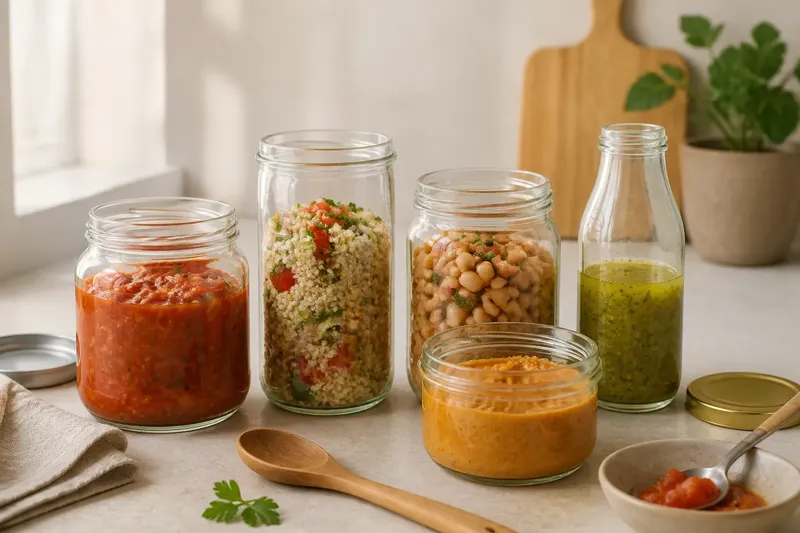
The common mistake with glass jar leftovers is treating every clean jar as useful storage; a narrow neck can turn a simple serving into a scrape-and-shake routine. Shape matters as much as capacity. The jar that suits a spoonful of dressing may frustrate you with cooked beans, while a broad-mouth jar can make chunky food easy to reach and awkward to pour.
Match the opening
A jar’s mouth determines what can pass through it comfortably. A wide opening welcomes a spoon, measuring cup, or chunky ingredients. It also makes it easier to see what remains and rinse the interior. That can suit cooked vegetables, beans, fruit pieces, thick sauces, and other foods you expect to scoop.
A narrow-neck jar has a different strength. Smooth liquids and pourable mixtures can move through its opening without needing a spoon to retrieve them. Think vinaigrette, broth, or a thin sauce. The neck can also help contain splashes when pouring, though a thick or lumpy mixture may clog it or leave food stranded inside.
Before saving a jar, imagine the whole trip: filling it, taking food out, and cleaning it afterward. If the opening only works for the first part, the container may become a nuisance rather than a useful spare.
Compare three shapes
Wide-mouth jars
These are the easiest to fill with a spoon and to empty without fishing around. They suit leftovers with pieces, dips, spreads, and foods you plan to eat directly from the container. Their broad opening is also useful when a spatula or small ladle is the right serving tool.
The trade-off is that thick foods can cling around the shoulder or inside the lid area. A straight-sided jar tends to be easier to scrape clean than one that narrows sharply toward the top.
Narrow-neck jars
These suit pourable foods and liquids that do not contain chunks. A smooth sauce can flow out; a spoonful of relish or a dense puree may not. They can be handy when the same container will pour into a bowl, but less convenient if you expect to serve by spoon.
Look at the inside as well as the rim. A narrow opening combined with sloping shoulders creates a tight corner where thicker leftovers can collect. If you cannot reach that area with the utensil you normally use, choose another jar.
Straight-sided jars
A jar with sides that stay fairly even from base to opening is versatile for scoopable foods. The contents remain visible, and a spoon can reach the bottom without working around a pronounced shoulder. This shape often suits grains, chopped fruit, or a small portion of stew, provided the mouth is wide enough for the pieces.
Straight sides do not make every jar interchangeable. A small opening can still limit access, and a very tall, slim vessel may be awkward to clean or serve from. Judge the shape and opening together.
Choose by the food?
Which jar suits chunky leftovers?
Choose a wide mouth with enough room for the pieces and the utensil you will use. A straight-sided jar is especially convenient when you want to scoop from the bottom without tipping the container.
Which jar suits sauces and dressings?
A narrow neck can work well for smooth, pourable mixtures, while a wide mouth is easier for thick sauces that need stirring or spooning. If the dressing contains herbs or other bits, make sure they can pass through the opening.
How do you judge a jar before saving it?
Try the utensil you expect to use and consider whether the food can enter and leave without forcing it through a tight neck. Also check that the jar is clean, intact, and appropriate for the intended storage.
Can a jar replace every food container?
No. A jar is useful only when its opening, shape, and lid suit the particular food and handling you have in mind. Some leftovers are better kept in a container with a broad, shallow opening or another form designed for the task.
Make the choice concrete
Say you have a clean, narrow-neck jar and a bowl of chunky tomato sauce. If you pour the sauce in, the pieces may lodge at the neck, and getting the last portion out could require awkward shaking. A broad-mouth jar would let you spoon it in and serve it cleanly; the narrow-neck jar could instead hold smooth vinaigrette that pours freely.
The useful question is not whether a jar is too small or too large in the abstract. It is whether its opening fits the food’s texture and your serving method. A modest jar with easy access can be more useful than a larger one that traps a portion you cannot comfortably reach.
Keep only useful jars
Glass jars can differ in finish and intended use, so check the label or manufacturer’s instructions when they are available. For ordinary leftover storage, keep the container clean and intact, and use a lid that fits properly. If a jar has a chip or crack, set it aside rather than using it for food.
There is no need to save every jar that passes through the kitchen. Keep a few shapes that serve different roles: perhaps a wide-mouth jar for spoonable leftovers, a straight-sided one for easy access, and a narrow-neck jar for smooth liquids. Let the food you actually keep determine the collection.
When choosing a glass jar for leftovers, picture the next meal, not just the moment you put the lid on. If you can fill it, reach the food, and clean it without a workaround, that jar has earned its shelf space.